Application · Precise Dosing
QB Precise Dosing
Software-defined precise dosing and titration for liquid processes — standalone or as an add-on to any bioreactor, skid or PLC.
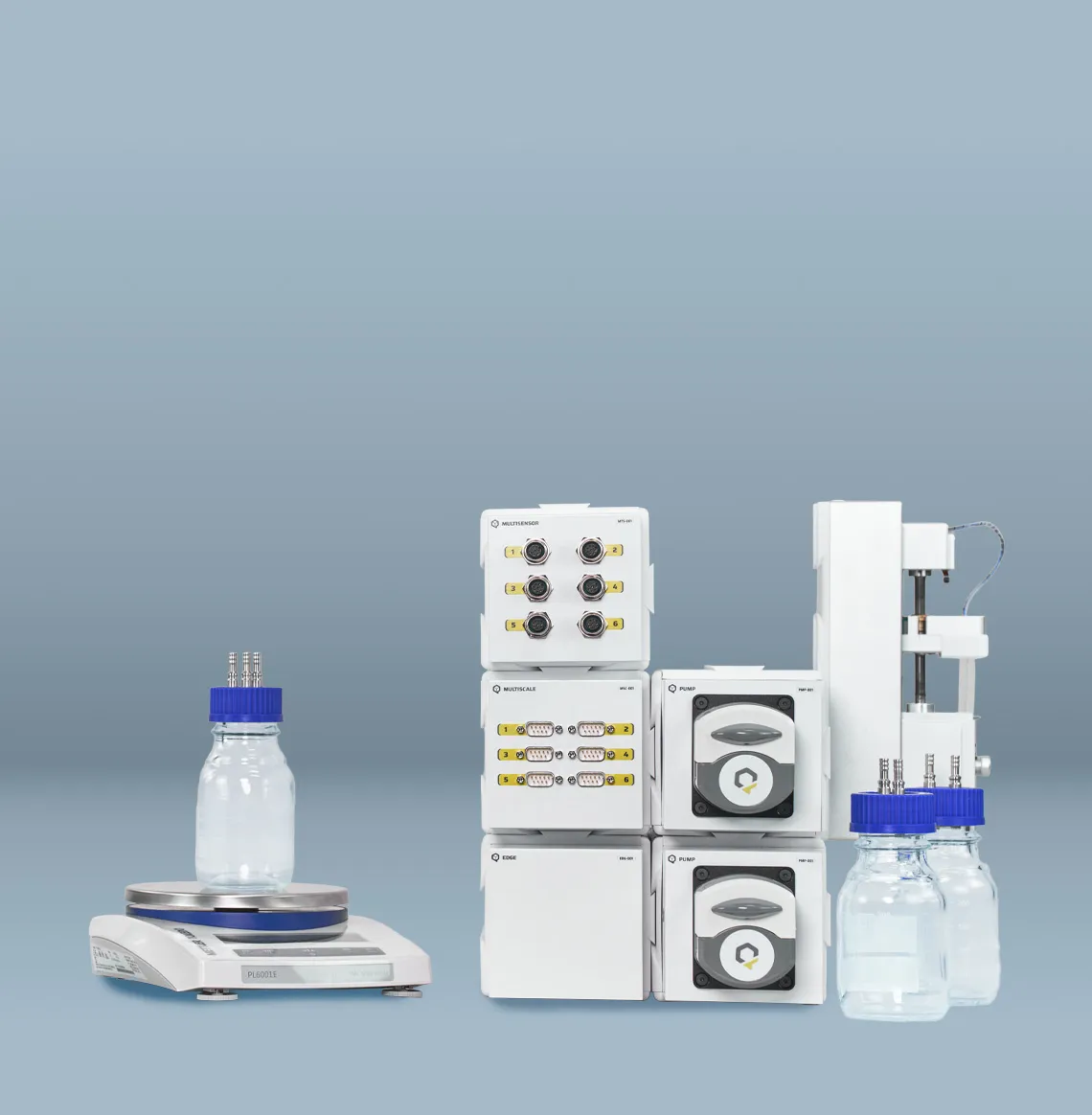
QB Precise Dosing is a modular platform for accurate dosing, feeding and titration in liquid handling. It is built from independent QB Modules — pumps, valves, balances, gas controllers and sensors — orchestrated by QB Control, and it is software-defined: what the system does, and how each module maps to each process, is configured through a no-code recipe rather than fixed in hardware.
Dose with peristaltic pumps, precision syringe pumps, or a centrifugal pump — in any combination — into a single vessel, a bag, a microfluidic cartridge, or many targets at once. Route through a shared path with a QB Selector Valve, or give every line its own dedicated path. Add a QB Multiscale and balances for gravimetric feeding or titration. Dose in sequence or in parallel. There is no software limit on how many sources and destinations a system can have.
Run it as a standalone dosing station, plug it into a QB Systems bioreactor, or add it to equipment from any other vendor — over OPC-UA where the controller allows it, or independently where it does not. Because QB Modules are compact, the solution most often fits inside a biosafety cabinet — and there are no annual software license fees.
Why dosing needs to change
The pumps aren't the problem — the systems around them are.
| The problem | What QB Precise Dosing does |
|---|---|
| Controllers ship with a fixed number of pumps, permanently wired in | Independent, hot-pluggable pump modules — add channels as you need them, no new controller |
| Peristaltic tubing wears and flow drifts days into a run | Gravimetric closed-loop compensation from QB Multiscale holds accuracy as tubing ages |
| Gas mixing lives in a separate box with its own software | QB GasFlow brings mass-flow gas control into the same platform and the same recipe |
| One dosing system rarely spans a mixed-vendor fleet | Vendor-agnostic; integrates over OPC-UA or runs independently alongside any controller |
| One pump technology can't cover every application | Peristaltic, syringe and centrifugal pumps share one bus, one controller, one recipe engine |
| Recurring software licenses erode the budget | Perpetual QB Control license — no annual software fees |
Advantages
Seven things that set it apart.
-
Software-defined, no-code recipes
Reconfigure modules, transfers, dosing and measurements through QB Control's no-code Recipe capability and a dynamic P&ID. Recipes are versioned and portable; auto-discovery means a new module appears the moment it's connected.
-
Modular, limitless scale
Start with a QB Edge and two pumps; grow to twenty or more channels through QB Switch expansion. No software limit on dosing sources and destinations — run many lines into many systems from one centralized QB Control.
-
Hybrid pumps
Mix pump technologies freely: peristaltic for feeds and perfusion, precision syringe pumps for micro-dosing and concentrated pH correction, and a centrifugal pump for high-volume recirculation.
-
Gravimetric dosing and titration
Add a QB Multiscale and balances for gravimetric feeding and titration. Closed-loop weight feedback compensates for tubing wear, with both loss-in-weight and gain-in-weight modes supported.
-
Shared, dedicated or combined paths
Use a QB Selector Valve to share a path across sources or destinations, give each line its own dedicated path, or combine both. Dose in sequence or in parallel across many vessels or bags.
-
Condition-based control from any signal
Software control logic can drive flow from pump RPM, flow rate or scale readings — or from any other signal such as agitation, temperature or pH — as the condition that governs feeding and dosing.
-
Unified liquid and gas, open connectivity
QB GasFlow adds mass-flow-controlled gas to the same recipe as liquid dosing. Native OPC-UA, MQTT, Modbus and REST, plus direct PLC connectivity and MTP, integrate with the automation you already run.
Where it stands apart
- Modular expansion to 20+ channels
- All three pump technologies — peristaltic, syringe, centrifugal
- Integrated gas mass-flow control (QB GasFlow)
- Up to twelve gravimetric balances
- One controller, one recipe engine — perpetual license
Ways to deploy
Four ways to deploy.
The right one depends on what you already own and how you want it controlled.
- 01
Standalone dosing station
A self-contained system controlled entirely by QB Control. QB Edge orchestrates the pumps, valves, balances and gas modules; QB Control provides configuration, the P&ID, recipes, alarms and logging.
- Simplest path when dosing or titration automation is the goal itself
- 02
Add-on to a QB Systems solution
On a QB Systems bioreactor or other QB solution, dosing is a native, plug-and-play extension. The modules join the same QB Control instance already running the process — one interface, one recipe, one audit trail.
- Feeding, gas and control loops live alongside the process
- 03
Add-on to a third-party system
Attach the dosing modules to equipment from any vendor. Integrate over OPC-UA where the controller supports it and coordinate with the conditions it already tracks, or run independently under QB Control where it does not.
- OPC-UA integration, or fully independent operation
- 04
Custom PLC integration
For a PLC-based installation, QB Precise Dosing integrates into the existing logic over OPC-UA using a QB Systems software connector — extending the feeding and dosing capabilities of a system you already run.
- Software connector into existing PLC logic over OPC-UA
Fluid paths, footprint & scale: choose shared-path dosing (with QB Selector Valves), dedicated lines, or a combination — with no software limit on sources and destinations. Compact modules mean the solution most often fits inside a biosafety cabinet, and many lines into many systems run from a single centralized QB Control.
System architecture
Choose modules, not a fixed appliance.
Core modules
| Module | Role |
|---|---|
| QB Edge (EDG-001) | Central controller and HMI. 10.1" touchscreen, Gigabit Ethernet, WiFi, PoE module ports; real-time orchestration; native OPC-UA / Modbus / MQTT / REST. |
| QB Control | Web-based control software. No-code Recipe Designer, dynamic P&ID, three control modes, alarms (ISA-18.2), audit trail, reporting. Perpetual license. |
| QB Switch (SWT-001) | Module-expansion hub. 4 PoE ports, daisy-chainable to connect 20+ modules. |
| QB Pump (peristaltic) | PMP-001: 3-roller, 0–300 rpm, 0.0033–365.69 mL/min. PMP-002: 4-roller, 0–600 rpm, 0.0079–2690 mL/min. Feeds, acid/base, perfusion. |
| QB Syringe Pump (SPM-001) | Precision syringe pump. 5–10 mL syringes, 0.001–50 mL/min, ±0.5% of set volume. Micro-dosing, concentrated pH correction. |
| QB Centrifugal Pump (PMP-003) | 0–13,000 rpm, 0–7.7 L/min, 1.0 bar max ΔP. High-volume perfusion recirculation. |
| QB Selector Valve | Rotary valve for switching between sources or destinations on a shared path. |
Optional modules
| Module | Role |
|---|---|
| QB Multiscale (MSC-001) | Gravimetric module. Up to 6 balances per module (12 with two); RS232; Mettler-Toledo (MT-SICS) and Kern balances. |
| QB GasFlow (GFC-001 / GFC-002) | Mass-flow gas control. 0.1 SCCM–2 SLPM / 0.1 SCCM–20 SLPM; 2 channels each; Air, Ar, CO₂, N₂, N₂O, H₂, He, CH₄. |
| QB Multisensor (MTS-001) | Up to 6 digital sensors; Hamilton and Mettler-Toledo probes, Levitronix/Sonotec flow meters, QB foam sensor. |
| QB Pressure Sensor (PRS-001) | Inline pressure monitoring (e.g. transmembrane pressure), up to 2 sensors. |
| QB Thermo (TCT-001 / TCT-003) | Temperature control for jacketed or small vessels. |
Software-defined, no-code recipes
Modules are represented and assigned in QB Control, and processes are built with a no-code Recipe capability rather than programmed. Recipes are versioned and portable between processes and systems, and a dynamic P&ID reflects the live configuration. Which capabilities are available depends on the licensing level applied.
Fluid-path configurations
Shared, dedicated, or combined.
| Configuration | How it works | Best for |
|---|---|---|
| Shared path | Sources or destinations switched through a QB Selector Valve. Fewer pumps and lines for the same reach. | Sequential dosing across many targets (e.g. one source to 16 vessels) |
| Dedicated path | Each line has its own independent dosing path — no shared surfaces. | Parallel dosing where carryover must be excluded (e.g. 8 bottles to 8 vessels) |
| Combined | Shared and dedicated paths mixed within one solution. | Real setups that need both efficiency and isolation |
Dosing can run in sequence (reusing a shared path across targets) or in parallel (independent lines dosing at the same time), to your preference.
Control, recipes & services
Three control modes, one system.
-
Manual
Direct control of pump speed, valve position and gas setpoint from device faceplates on the P&ID. For setup, troubleshooting and quick tests.
-
Semi-automatic
Control loops (services) triggered manually and running independently. For process development and parameter exploration.
-
Full-automatic
The no-code Recipe Designer drives all services with conditional logic (IF-THEN), split/merge parallel paths and wait-until triggers. Draft / Validated / Archived workflow and a Batch Board for multi-process monitoring.
Dosing-related services
- Constant-flow & volume-based pump dosing
- Gravimetric mass-based transfer (titration & feeding)
- Precision syringe dosing
- pH control (base pump and/or CO₂)
- Glucose control (PID from a glucose signal)
- Transmembrane-pressure control (perfusion)
- Antifoam control
- Gas services (set flow, volumetric, mixed-gas ratio)
Technical specifications
At a glance.
| Pump channels | 2 (base QB Edge) to 20+ via QB Switch expansion; each an independent module |
| Peristaltic pumps | PMP-001: 3-roller, 0–300 rpm, 0.0033–365.69 mL/min; PMP-002: 4-roller, 0–600 rpm, 0.0079–2690 mL/min |
| Syringe pump | SPM-001: 5–10 mL syringes, 0.001–50 mL/min, ±0.5% of set volume |
| Centrifugal pump | PMP-003: 0–13,000 rpm, 0–7.7 L/min, 1.0 bar max ΔP |
| Gravimetric system | QB Multiscale MSC-001: up to 6 balances per module (12 with two); RS232; Mettler-Toledo (MT-SICS) + Kern |
| Gas flow control | QB GasFlow GFC-001 (0.1 SCCM–2 SLPM) / GFC-002 (0.1 SCCM–20 SLPM); 2 channels each; Air, Ar, CO₂, N₂, N₂O, H₂, He, CH₄ |
| Process sensors | QB Multisensor MTS-001: up to 6 sensors; Hamilton + Mettler-Toledo, Levitronix/Sonotec flow, QB foam sensor |
| Targets | Vessels, bags, bottles, microfluidic cartridges — single or many, in sequence or parallel |
| Fluid paths | Shared (QB Selector Valve), dedicated, or combined |
| Control modes | Manual, Semi-automatic, Full-automatic (no-code Recipe Designer) |
| Communication | OPC-UA (server + client), MQTT, Modbus, Profibus, Serial, 4–20 mA, 0–10 V, REST API, SQL, LDAP/AD, MTP, PLC (Wago / Siemens / Beckhoff) |
| Controller | QB Edge EDG-001: 10.1" touchscreen, Gigabit Ethernet, WiFi, PoE ports; 310 × 270 × 115 mm, 3.5 kg, IP40, CE |
| Footprint | Compact modules; the solution most often fits inside a biosafety cabinet (BSC) |
| Compliance | Audit trail and data integrity via QB Control; ISA-18.2 alarm management; CE marking |
| Licensing | Perpetual QB Control license — no annual software fees |
Note on electronic signatures: QB Control provides an audit trail, alarm management and data integrity. Electronic signatures are on our roadmap and coming soon; until then, e-signature workflows are handled through the customer's LIMS or quality management system.
Applications
Configured for the job, not the equipment.
-
Microfluidics & micro-dosing
Syringe pumps dosing precisely (2–10 mL) into a target solution or a microfluidic perfusion chamber or cartridge.
-
Flow- & weight-based feeding
Peristaltic pumps feeding one or more bioreactor vessels based on flow rate, or on source-scale readings with a configured feeding flow rate.
-
Multi-source blending
A combination of syringe and peristaltic pumps dosing from several source bags or bottles into a target vessel, bag or bottle.
-
Sequential vs parallel dosing
Dose glucose in sequence over a shared path to 16 vessels, or dose nutrients in parallel over separate paths from 8 source bottles to 8 vessels.
-
Gravimetric perfusion feeding
Single-line gravimetric feeding to one bioreactor, or independent lines to several — all from one QB Control, with transmembrane-pressure control where needed.
-
Extending a PLC-based system
Add feeding and dosing capability to an existing PLC-based installation over OPC-UA using a QB Systems software connector.
Frequently asked questions
What can QB Precise Dosing dose into?
Single or multiple targets — vessels, bags, bottles, or even a microfluidic perfusion chamber or cartridge. Dosing can run in sequence or in parallel across many targets. The target system has no limitation beyond the tubing.
Which pumps can it use?
Any combination of QB peristaltic pumps (3- and 4-roller), precision syringe pumps, and a centrifugal pump — all sharing one controller and one recipe engine, so you configure for the application rather than the equipment.
How does gravimetric dosing and titration work?
A QB Multiscale connects balances (up to 6 per module, 12 with two) and QB Control closes the loop on weight — compensating for tubing wear and supporting both loss-in-weight and gain-in-weight modes for titration and gravimetric feeding.
Can I add it to bioreactors I already own?
Yes. It runs standalone under QB Control, plugs natively into a QB Systems solution, or attaches to a third-party system — integrated over OPC-UA if the controller supports it, or running independently if it does not. PLC-based systems integrate over OPC-UA with a QB Systems software connector.
What is the difference between shared and dedicated paths?
A shared path uses a QB Selector Valve to switch one line across several sources or destinations (efficient for sequential dosing). A dedicated path gives each line its own independent route (no carryover, ideal for parallel dosing). Both can be combined in one solution.
How is it programmed?
Through QB Control's no-code Recipe capability with a drag-and-drop designer and dynamic P&ID — no coding. Recipes are versioned and portable between processes and systems. Control logic can act on pump RPM, flow rate, scale readings, or any other available signal such as pH or temperature.
Are there recurring software license fees?
No. QB Control ships under a perpetual license with no annual software fees. Optional support tiers add updates and priority response, but the system keeps full functionality regardless.
Does it support 21 CFR Part 11 / electronic signatures?
QB Control provides an audit trail, alarm management and data integrity. Electronic signatures are on our roadmap and coming soon; until then, they're handled through the customer's LIMS or quality management system.
See QB Precise Dosing configured for your process.
Request a live demonstration, discuss a standalone or add-on deployment, or get a configuration matched to your pumps, targets and workflows.
Contact us
Thank you! Your message has been sent — we’ll be in touch shortly.
Sorry, something went wrong sending your message. Please email us directly at [email protected].